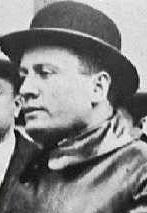
How many of the twentieth-century’s vicious dictators also wrote a bodice-ripping historical novel? The answer is at least one, that one being Il Duce himself, Benito Mussolini.
In 1909, the future leader of Italy was secretary to a trade union organisation in Trent, and assisting the editor of the local socialist newspaper Il Popolo and its weekly supplement La Vita Trentina. For La Vita Trentina he wrote a serial, the extravagantly titled Claudia Particella, l’Amante del Cardinale: Grande Romanzo dei Tempi del Cardinale Emanuel Madruzzo. Apparently the story was popular with the readers of the magazine, but with the passage of time it was forgotten and it was not until 1929, after he had been in power for more than six years, that it was rediscovered and published in book form, with English and German editions appearing shortly after.
Mussolini’s story is about a historical figure, Emanuel Madruzzo, Cardinal of Trent during the papal reign of Alexander VII (1655-1667), his mistress Claudia Particella, and the unhappy course of their love affair. Madruzzo wants to resign his cardinalcy and legitimise the relationship, but the pope will not permit it; meanwhile the couple’s enemies inside and outside of the church are increasing in number and determination, as first Emanuel lavishes the town’s wealth on Claudia then compounds his sin by carelessly bringing about the death of his niece and hiding her body. The dastardly Don Benizio could help them, but only if Claudia will yield to his lusts: she spurns him, sealing her fate. Assassins are recruited and several attempts are made on her life; finally they succeed in drugging her wine and she dies. Madruzzo lives on, presumably unhappily ever after.
You may gather from my synopsis that this is not great literature, nor would you expect it to be, given its author. But a book does not have to be great literature to be worth reading, if it has, say, a fast-moving plot, interesting characters, humour - intentional or otherwise - or a smattering of lubricious sex. None of these things are to be found here, sadly.
The plot wanders, betraying both its nature as a serial publication and its author’s lack of serious interest in his story. A similar carelessness mars his characterisation, so that it is hard to say whether his two protagonists are supposed to be sympathetic or not. He does not really care what they do, or what happens to them: it seems that he is writing about them only because the historical setting provides an excuse for lengthy anti-clerical rants, and to portray the lust, vengefulness and murderousness of their adversaries. For him, love is merely a convenient motivating device that can be evoked by well-worn formulae, while hate is real.
Mussolini the dictator has often been portrayed as a comical figure, but there is not much fun in this book. The prose is often purple and overblown but it is rarely silly enough to be amusing (of course the Italian original may be different in this respect, but not being able to read it, I can’t say). But here is one of the few truly enjoyable over-the-top passages, part of Don Benizio’s vain attempt to seduce the lovely Claudia:-
Don Benizio wept like a boy. And like a boy he knelt at Claudia’s feet. With broken phrases, interrupted by terrible groans which burst from his breast, with words which were in turn puerile, disordered, suave, and terrible, with the desperate gestures of one who has been crushed, he begged love, pardon, pity.
“Do not cast me into the abyss. Do not make me drain the bitter cup of vengeance. Cast a ray of your light into my darkened soul.”
Then phrases of mystic adoration hurtled past his lips.
“I will build you a secret altar in the depths of my conscience. You will be the Madonna of the temple within me. I will be your slave. Strike me, despise me, beat me, open my veins with a subtle dagger, but grant me the revelation of yourself, grant that I may speak to you, grant that I may lose myself with you in the supreme illusion.”
But Don Benizio’s eloquence did not move Claudia. Then the priest returned to thoughts of vengeance.
“Ah, you do not listen to me, shameless courtesan, harlot. Well, I shall come to get you in this same castle. I shall let the common brutes of the market-place satiate their idle lusts on your sinful body. You shall be the mockery of the unreasoning mob. Your corpse will not have the rites of Christian burial. You will be cast into the field of the Badia with the witches. And when the hour of your agony comes, when, trampled on, transfixed and rent by the blows of the mob, you shall implore aid and succour with the eyes which now so disdainfully regard me, I shall be the evil demon of that supreme hour, I shall come to torture you with memories of me, to gloat in my triumph.”
One nice image there: where those ‘phrases … hurtled past his lips’, and elsewhere there are other occasional happy coinages, such as where some prelates are ‘eyeing her with hostile snouts’, but mostly it is tedious bombast without even such dodgy metaphors to lighten it.
The preface to the English edition, by the translator Hiram Motherwell, says that this was Mussolini’s sole excursion into fiction, apart from one, reportedly morbid, short story. One must assume that despite the supposed success of his serial with readers of La Vita Trentina, he did not see himself as a historical novelist, perhaps because he was aware of his limitations as a writer: if so, the lazy pop-psychological explanation of the dictator as frustrated artist will not fit in this case.
That it is not a more interesting book is a shame: one would like, in answer to the query: “What are you reading at the moment?”, to be able to answer smugly: “The Cardinal’s Mistress, by Benito Mussolini”, and hint by smirk and wink that this is the sort of meat only appreciated by the cognoscenti: gamey, adventurous; something rich and strange: but unfortunately it is merely rotten old tripe.
Come on, folks; What is
What is important here is not to critique Mussolini's skills or talents as a writer. No, not at all. What is important here is to ask and answer the following questions: What was it about this man that allowed him to take center stage in Italian history for more than two decades? What about this man caused Winston Churchill and Franklin Delano Roosevelt (prior to WWII) praise him?
And, is there anything revealed in this man's novel, anything at all, that would portend those events occuring in his life?
Hmmm?
Thanks for listening,
Davy Jones
What is important here is
Bollocks. Don't tell me what's "important" on my own website, you nincompoop. This page is about the book, not about that puffed-up creep Mussolini. If you want to write a different article, in which you masturbate feverishly over the great man and his horrible enterprise, fine. Just do it somewhere else, you facile, weak-minded, cacophilic poltroon.
"Thanks for listening"? Piss off
Mussolini wasn't the only
Nifty! I gather that Saddam
I gather that Saddam Hussein wrote (or ghostwrote) several novels, the titles of which sound like they were made up by Italo Calvio.
http://en.wikipedia.org/wiki/Saddam_Hussein%27s_novels
It would not surprise me in the least if the works of more dictators could be found. Perhaps Alfred Armstrong could even make a section of his excellent site for these curious objects.
A quick search reveals that Kim Jong Il wrote a book out of his field of expertise called "On the Art of the Cinema" and another "Kim Jong Il on the Art of Opera: Talk to Creative Workers in the Field of Art and Literature " who's product description on Amazon.com says, if you can believe it: "The harmonious whole between the leader and the leader that has been all the more consolidated with belief and cemented with filial obligation is the most valuable gain of our revolution, as well as the source of the Republic's invincible power."
I really fancy the Kim Jong
I really fancy the Kim Jong Il ones, actually.
But a book does not have to
Very amusing. But:
it is hard to say whether his two protagonists are supposed to be sympathetic or not
This, to me, could be a favorable description of sophisticated fiction. I'm certainly not expecting that, given the author and your review, but your line, to me, is not the criticism you intended.
Good point. I guess what I
Good point. I guess what I was trying to get at is that he takes little care to make them real to the reader, sympathetic or not. In much second-rate fiction the characters become subject to the needs of the plot, rather than it seeming to arise out of their nature: but here neither plot nor character seems to matter.
Has anonymous entertained
Assuming nothing else had managed to set warning bells off before.
Can't wait to read it. I'm sure it's a "laff riot."
It seems as if I have found
Never heard of this book
I agree with those who say
In the period when he was writing this book he was writing a good deal of other garbage and putting together his jerkwad political philosophy. His whole life was socialism. To say that this book is somehow distinct from all of that is really crazy.
It would be akin to saying that Hitler didn't inject his ideals into German art.
Although I agree that it is vaguely possible for Il Duce to have created a book without injecting his ideals into it the review of the contents makes it clear this was not the case as anti-clericalism reportedly was part of his beliefs at that time.
Horrendous paper. Frankly,
You again? Still posing as
You again? Still posing as an idiot, I see.
I think that this paper is
Yes, it's true, I am biased
Yes, it's true, I am biased against this book and its author by actually having read it. I am equally biased against you, because you seem like an idiot.